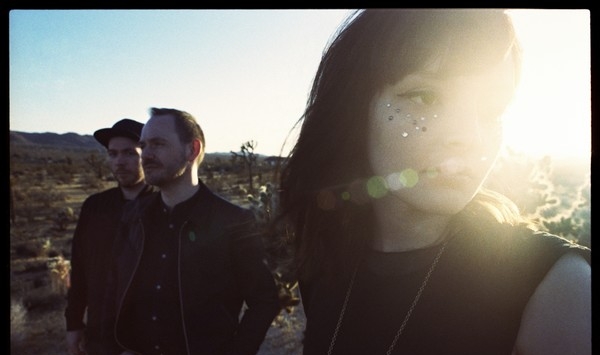
Though, given the relatively drastic musical shift, they do have some reservations about being labelled a pop band. “We don’t think of ourselves, per se, as a pop band,” says Cook. “I think that might be more of an ideological difficulty in accepting the perceived disposability of pop music. It’s by its very nature disposable, because it happens in the moment. Sometimes it’s something that feels great the first time you hear it, then it wears off really quickly. I feel like our music doesn’t have that disposability thing. Maybe it’s because we’re a bit older or something. We’re not writing music that’s so now and buzz and gone tomorrow.”
Cook’s misgivings aside, it’s easy to agree with him regarding the inherent substance of the band’s songwriting. Despite having an immediate, crowd-drawing appeal, which fast-tracked Chvrches onto club sound systems, radio playlists and festival main stages, the quality of The Bones of What You Believe doesn’t weary after repeated listens. This is also true of the band’s second LP, Every Open Eye, which is out this Friday.
“When I first got in the studio with Martin way back in September 2011, there was definitely a sense of wanting to lay aside that more brooding sound and do something that felt more like the kind of music we wanted to hear at the time and that we wanted to communicate with a larger audience,” says Cook. “We were sick to death of playing to half full rooms of really intense bearded guys. Don’t get me wrong, we are those really intense bearded guys and still love that music, but it’s quite narrow. When you create music within a genre, you have a range of creative choices that you can make without stepping too far outside the box. We wanted to start doing something with no road map and no restrictions. And we just gravitated towards these sounds.”
Cook and Doherty might’ve conceived Chvrches as a means of departing from their stony-faced past, but a band with purely reactive foundations is unlikely to endure beyond the initial spark. The Bones Of What You Believe introduced Chvrches as a savvy songwriting collective, and Every Open Eye cements their place at the forefront of contemporary electronic indie pop. It’s no surprise, then, that Cook’s been interested in this sort of music for years.
“I had bought a Minimoog Voyager synth that summer [2011], because I wanted to start doing more electronic music and I was drawn towards analogue synths,” he says. “Some of my favourite music of all time is made by and inspired by that instrument – the Minimoog. I really wanted to get one and see what happened when it was in my studio. So Martin and I just focused on that and used that as a jumping off point.”
The pair were immediately taken aback by how quickly they found their groove. “The hooks that were coming out were just like somebody had turned on a tap,” says Cook. “The huge melodies, it was like ‘Where the hell did that come from?’ I’d never had that sort of collaboration and experience with anyone else in my life.”
Every Open Eye arrives bang on two years after the band’s debut. During that time, Chvrches have risen from relative nobodies to globally revered, chart topping, touring musicians. Thankfully, the profile boost hasn’t diminished the trio’s prolifically constructive creative dynamic.
“We were on tour for two years pretty much solidly and hadn’t been in the studio together really, apart from two songs that we did [Dead Air and Get Away],” says Cook. “We were absolutely desperate to get back in the studio again after all that time away, and almost immediately it felt like someone had turned on a tap again and we were writing one new idea a day. We surprised ourselves by the pace of writing this record.”
The rapidity of the writing process wasn’t the only surprise Cook encountered during the creation of Every Open Eye. “The biggest surprise for me was how much Lauren stepped up lyrically and vocally,” he says. “We didn’t know what her lyrics were going to be like, thematically, tonally, and when she got properly into her swing we were like, ‘Wow. This is beyond what I was expecting.’ It feels like a big step up from the first album. The lyrics on the first album were written a lot more collaboratively. But the second record, apart from one song, was exclusively Lauren’s vision for the lyrics.”
In his former musical life, Cook often felt constricted by the chosen genre territory. With this in mind, when Chvrches got to work on Every Open Eye, they refrained from nominating specific goals they wanted to reach, stylistically or otherwise.
“We never sat down and said, ‘Let’s write poppy electronic dance music.’ We’re just following our nose and following our taste. That was pretty much what steered the ship on the first record and exactly the same on record two. We didn’t discuss before we went into the record how we wanted it to sound. There was no premeditation.”
The result is an album big on vocal hooks, lyrical intrigue, biting synthesisers and summer-beckoning grooves. Every Open Eye is arguably more outwardly pop-oriented than it’s predecessor, which corresponds with the one premeditated aim the band did abide by.
“We wanted to have fewer elements in each of the songs, arrangement-wise, because we wanted the individual sounds to breathe, and for the arrangements to be more lean and have more space for the vocal. On the first album, for example, if we wanted a bass sound on a particular track, we would layer it with about five bass sounds to make it huge. But by doing that you actually make it sound small, because you’re taking up all the available space.
“Listening back to a lot of our favourite pop music from the past, particularly Quincy Jones, the stuff he did with MJ – those arrangements are so lean and they’re so tight and it’s all about the interaction between the rhythm of the drums and the rhythm of the vocals, and allowing those two things to play off each other without anything else taking away from that.”
As well as gleaning from Jones’ production on Michael Jackson’s Off The Wall, Bad and Thriller LPs, the band took cues from a few other prominent artists. “We’ll be like, ‘That Kate Bush moment in such and such a song or that mood in a Radiohead song or that big moment in a Depeche Mode song.’ The music that we share a love for is the stuff that we tend to reference in the studio.
“With this band as much as in any band, we definitely decided our parameters early on. We’re not going to go onto album two and write this orchestral-experimental piece of music. We know what we’re doing in terms of we’ve designed those boundaries and now we’re working within them. We don’t really need to, or want to, bring in too many external influences, certainly not at this point in the band’s career.”
All of the aforementioned artists attained pop saleability without compromising their artistic integrity. This brings us back to the idea of Chvrches as pop band – which Cook concedes isn’t necessarily a negative denomination.
“It’s obviously not a disposable thing when you look back at all of the great, classic songs that have been written that you would consider pop music of the time,” he says. “You look at great pop art, like Lichtenstein and Warhol – that stuff was designed to be throwaway and disposable, but has become canonised as some of the great art of the 20th century. It’s a tricky one. It’s a name that we struggle with sometimes, but essentially it is pop music [laughs].”
BY AUGUSTUS WELBY
