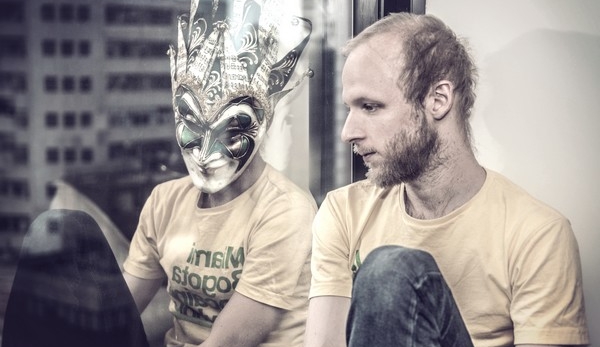
After making his inaugural Australian visit for last year’s event, Germany’s Boris Brejcha is heading back to Earthcore for another year. Brejcha will close proceedings on the main floor on Friday night and he’s thrilled to be returning to Pyalong. “You can compare it with a great festival in Brazil,” he says. “It’s like somewhere in the desert, there’s nothing there except this festival.”
The festival’s rural setting is a sure contrast from the nightclubs and urban centres most of the performers are accustomed to. Brejcha’s been a globetrotting DJ and producer for the better part of a decade now, but when he’s not dizzying punters from behind the decks, he reverts to a small-town lifestyle.
“I’m living in a little village called Frankenthal,” he says. “It’s really small. We have no parties in our town. In general, I’m not a city guy. I like the countryside much more. It’s better for me.”
Many of the world’s established DJs admit to spending their formative years revelling in the club environment, which prompted their interest in disc spinning. For Brejcha, it was the ear-expanding possibilities of electronic music that attracted him to production.
“I never went to clubs when I was young,” he says. “I was in school and then there was one guy, he’d bring us a double CD, it was hardcore music. It was the very beginning of this kind of music. I was just getting interested and was listening to this hardcore music and then I switched over to rave music and then I switched over to techno music.
“Then we had the first radio station which was playing techno music. At this time I was 12 years old. It was really amazing to hear such new sounds, besides guitar or drums. I was getting more and more interested in how this sound was working and how can you do that. Then I met a friend in school and he had a program that was beat-based and he showed it to me and I tried a lot of stuff with that.”
Brejcha’s earliest forays into production were modeled on the work of trance music titans Paul van Dyk and Armin van Buuren. However, it was when he discovered techno his creative proclivity developed into an obsession.
“In the beginning, I was listening to trance music and hardcore,” he says, “but then when I turned into techno music I was just sitting in the studio every day making music.”
Brejcha’s reluctance to get involved with German dance music’s hedonistic culture actually led to the cultivation of his unique production approach. These days, he describes his sound as high tech minimal, which applies electro colour to minimal techno. “I did not ever listen to any other techno artists,” he says, “so I had not many influences. I think that was a big thing to create a unique style, because I was doing the music [the way] I like to do it.”
Early on, though, he was more or less unaware of this distinction. “A lot of people told me that my music was kind of different, because I had this really strong beat but I also used a bit psychedelic melodies, but I did not get it.”
After years spent tinkering in isolation, Brejcha started to plot a career in the music industry. The idea of getting involved in live performance however – and thus having to go out to dance parties – was something of an afterthought.
“I was just sitting at home producing and I was thinking OK, ‘Let’s do music, sign it to a label, they will make a video for MTV and then I’ll get the money from that’. That was the main thing I was thinking.
“In 2006 we released my first release [the Monster EP on Berlin’s Autist Records], then after two months I got the first booking request from Brazil. It was a new world. I was searching for, ‘How can I do it?’ and then I was going to Brazil with a laptop. But in the end it worked out and then gigs were coming more and more. I have to say, I like more to sit in the studio to make music. That’s the main reason why I do it.”
No matter how biased he is in favour of spending hours in the studio, if one’s to stay afloat in the music biz, touring is an absolute necessity. Not surprisingly, Brejcha’s DJ sets are greatly influenced by his studio obsession. “When I’m on stage you can be sure that I play only the tracks I did in the past on my album and I mix it with a lot of unreleased tracks. Every time, I keep it fresh. I play mostly 70 per cent unreleased tracks.
“I sometimes see other DJs and they play two hours straightforward music. I think that’s not the way to go. You really like to have good times and bad times – highs and ups. When I play, I like to combine it. I like to play two or three tracks with melodies and then go back to my harder stuff and then coming back to the melody. It’s the up and down. I think it’s the best way.”
Another point that differentiates Brejcha from many of his contemporaries is his unflagging commitment to making and releasing albums. At a time when CD stores look increasingly like aboveground cemeteries, Brejcha holds on tightly to the long-playing format. In fact, his latest release is the most elaborate of his career. Album number four, Feuerfalter is a two-part epic, with one disc designed for the club and one for the home.
“If you do just an EP with one or two tracks then it comes out [along with] hundreds of that, I think that’s not so good. If you have albums with ten or 11 tracks, you can tell a story. You can inform more people with that, if you make an album rather than release just one EP.”
Even though electronic music has long since transformed from a keen interest into a demanding occupation, Brejcha’s fascination with electronic sounds hasn’t dimmed whatsoever.
“With rock music, with instruments like drums or guitars, there’s nothing evolving,” he says. “[With] electronic music, you can do everything. It’s evolving every time. I think it’s the most interesting music for the future, because pop music is now electro music. Everything is changing.”
BY AUGUSTUS WELBY