Set in an Italian post-production studio circa 1976, this inventive film by British writer-director Peter Strickland is going to delight an array of audiences. Horror fans, film buffs and audiophiles are all catered for in its creepy, self-contained world. The excellent Toby Jones leads us inwards as Gilderoy, a meek documentary sound effects mixer hired by the eponymous studio to work on The Equestrian Vortex – a stupendously titled exploitation film from the Italian giallo mystery/horror genre, of which Dario Argento’s Suspiria is perhaps the best known. Stuck between a choleric producer and a priapic director, Gilderoy is forced to mutilate vegetables and record the endless screams of actresses to soundtrack scenes featuring witches, torture, and, at one point, “a dangerously aroused goblin”. As the environment begins to take on a sinister, Lynchian quality, Gilderoy’s psyche slowly unravels against the film’s immaculate soundscape (which also features music by pop experimentalists Broadcast, recorded before the passing of Trish Keenan).
By the time Strickland’s offbeat hymn to sound effects opens at ACMI, we’ll know if it succeeded in its seven nominations at the British Independent Film Awards. Given that his first film Katalin Varga, a revenge drama set in rural Romania, sat on the shelf for years after filming, Strickland is relieved to admit that luck has been onside for his follow-up.
“When I made my first film it was just impossible … That film took five years to get out,” he recalls. “It took two years to get all the funding in place for Berberian, which for me was very fast.”
Hopeful that Berberian’s wider success will make realising his next project easier, Strickland remains cautious. “The problem with filmmaking as opposed to literature or even music, is that you’re only as good as your last film … In your early days you’re just terrified of making a film that doesn’t do well either critically or commercially, because then that’s it, you’re out.”
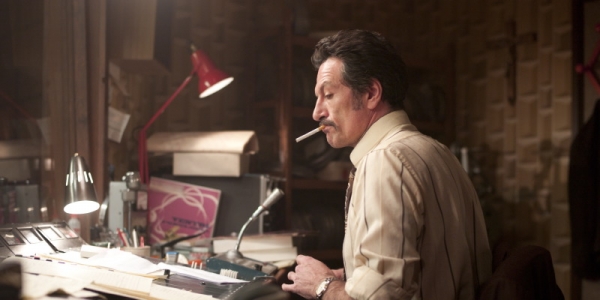
The cinematic realm of Berberian Sound Studio feels at once dreamlike and authentic, unreal and yet lived in. As Strickland says, “Something quite immersive … that exists in its own world; that’s the cinema I enjoy watching and making.” Its mise en scene is peppered with the kind of vintage, analogue equipment that makes gearheads weep, and the studio itself looks like could well have existed somewhere in the backstreets of ‘70s Rome.
“Yes and no,” he explains. “There were two types of studios: the musique concrete electro-acoustic studios that people like [modern composers] Stockhausen and Luicano Berio would be using – lots of valve technology, very equipment-based. The actual film post-production studios didn’t have that much valve technology … I wanted to cheat and have the best of both worlds; this big auditorium coupled with a mixing room full of all that gear. I was creating this fantasy studio that I always wanted to exist.”
Fantasy or not, Strickland was careful to ensure that what the audience hears appeared to be created onscreen. “We took a very specific list of equipment from Berio Studios – his wife, Cathy Berberian, she did a piece of this very intense howling which inspired the whole film – [but] it’s just so hard to get that gear now! That generation, they died or they retired and didn’t have the nostalgia for that equipment. A lot of it ended up in skips … We got some, which was great, and we actually use those machines at times to make those exact sounds.”
Another example of the film’s almost obsessive attention to detail comes in its inclusion of “Screamers” and “Special Guest Screamer Suzy Kendall” in the credits. Be forewarned, there is a lot of screaming in Berberian Sound Studio. Just how much did Strickland listen to while doing his own post-sound? “It wasn’t just post, it was even a year before shooting. Screams were being done all the way through,” he tells. “I wanted to have a lot of that stuff to play to the actors on set. It was a mix of friends doing it, the actors doing it … the woman who played Claudia (Eugenia Caruso) did a lot because she had this phenomenal voice for screaming. We’d then manipulate them and put on more aggressive distortion or tape delay … Suzy Kendall, she came after we shot the film, which is surreal for me because her film The Bird With The Crystal Plumage [by Dario Argento] is the first giallo film I ever saw. She did all the screams in post-production for that film – so it got a bit meta to see her in this glass booth, screaming for a film that we’d just done.”
And did so much screaming have any effect on Strickland, as sound so fearfully does for Jones’s Gilderoy?
“It does get into your head after a while,” he admits. “It’s weird because you’re in the studio in a comfortable atmosphere, biscuits on the table … screaming always seems ridiculous in the studio. But I think once you’ve manipulated it, it just transforms itself – and that’s what the film evokes really, the idea of innocent sounds becoming corrupted and becoming very dark.
“The sound of someone stabbing a cabbage, we don’t normally associate that with a horror film. It’s just what we hear when we’re cooking dinner. But when that sound becomes corrupted by association, it messes with your head. Even though everything is artifice, even though we know it’s all fake, it still gets to you.”
BY CHRIS HARMS