Welcome to the most hectic itinerary you'll ever see. Reddit said we couldn't do it, but here we are a glorious month later, with all the information you need.
It started with fried chicken and beer in a converted shoe factory in Seoul and ended somewhere above the South China Sea, sunburnt and fully wrecked in the best possible way.
In between: rainbow mountains, sand dunes the height of skyscrapers, turquoise lakes that don’t look real, Avatar-pillar hiking trails, a three-Michelin-star dim sum lunch, and enough overnight trains to last a lifetime. Beat did the full run — Seoul, Beijing, Xi’an, the Silk Road fringe, Chengdu, Jiuzhaigou, Zhangjiajie, Fenghuang, Yangshuo, Shanghai, Hong Kong, Macau, Taipei — and came back with opinions.
Days 1–2: Seoul — Seongsu-dong and First Impressions
The plane lands at Incheon and you’re straight into it. A 43-minute express train deposits you at Seoul Station, and from there it’s a short metro hop to Seongsu-dong, the neighbourhood the internet has been obsessing over for good reason. Think Melbourne’s Fitzroy but denser, more vertical, and with better coffee. A former industrial district of converted shoe factories now houses concept stores, roasteries and art spaces, all crammed onto streets that reward wandering without a plan. Daelim Changgo — a gallery-café operating out of a converted warehouse — is one of those places that makes you feel like you’ve stumbled onto something, even if everyone else has clearly already found it.
Seoul Forest sits a ten-minute walk from Seongsu station: a sprawling urban park with deer enclosures and elevated tree canopy walkways that felt genuinely peaceful at dusk. Later, we caught Brutalismus 3000 playing a basement venue in the same neighbourhood — the Berlin nu-gabber punk duo absolutely demolished a small room, and it set the tone for a trip that was going to be very long and very good.
Day 3: National Museum, Lotte World Tower and Gwangjang Market
The National Museum of Korea in Ichon is enormous and free, which is an almost offensive combination. The Silla gold crowns alone justify two hours. After that, the Lotte World Tower Seoul Sky observation deck on the 117th–123rd floors delivers the kind of 360-degree view that makes you understand what a city actually is — the Han River threading through the basin, mountains ringing every horizon, the whole thing glowing gold in the late afternoon. Go around 4–5pm to catch the light shift. Gwangjang Market was the evening move: bindaetteok (mung bean pancakes) and mayak gimbap from vendors who’ve been doing this for decades.
Day 4: DMZ and the JSA
The DMZ/JSA half-day tour is not like other tourist experiences. Standing in one of the blue UN buildings that straddles the border between North and South Korea — one foot technically in the North — is a genuinely strange moment. The Third Tunnel of Aggression (dug by the North, discovered by the South) and Dora Observatory complete the picture. It’s heavy and fascinating and unlike anything else on this continent. Book well in advance; authorised operators require passport details and there’s a strict dress code at the Joint Security Area.
Day 5: Busan Day Trip — Gamcheon and Haedong Yonggungsa
The KTX bullet train covers Seoul to Busan in under three hours and it’s worth every minute. Gamcheon Culture Village spills down a hillside in pastel blues, pinks and yellows — narrow staircases connecting cafes, murals and unexpected viewpoints. It earns the Santorini-of-the-East comparison. But the real highlight was Haedong Yonggungsa Temple: a sprawling Buddhist complex built directly onto ocean rocks, with the East Sea crashing below the prayer halls and pagodas. Arriving by late afternoon, with the sea mist rolling in, it was one of the most dramatic places we visited on the entire trip.
Day 6: Gyeongbokgung, Gangnam and Underground Techno
Seoul’s big palace, Gyeongbokgung, earns its reputation — the ceremonial gates and main throne hall are genuinely imposing at scale. Changdeokgung’s Secret Garden is the slower, better sibling: a 300-year-old landscaped garden of pavilions, ponds and ancient trees that the palace’s royal family used as a private retreat. By night, the city shifts register entirely. Faust in Itaewon — running a Kirsch Audio system — and Cakeshop (200 capacity, exposed concrete, no-nonsense) are the picks for underground techno. Both are the real thing.
Day 7: Seoul Bathhouse, Hongdae Busking and Departure Morning
Siloam sauna and bathhouse near Seoul Station is the correct way to spend a final day in Seoul. Multiple hot and cold pools, a jjimjilbang (heated rest room), massage options — it’s a full afternoon of doing nothing constructive and feeling excellent about it. Hongdae busking picked up in the evening: the area around the university is genuinely lively most nights, with street performers drawing large crowds along the main strips. Noraebang (private karaoke rooms) are everywhere; at least one session is mandatory.
Day 8: Beijing Arrives
The flight from Seoul to Beijing is just over two hours and lands you in one of the world’s most overwhelming cities. We checked in near the Wangfujing area and spent the evening at Houhai Lake — a ring of water lined with bars and restaurants, lanterns reflected on the surface, locals cycling the promenade. Tiananmen Square at night, drained of its daytime crowds, is a different proposition to the tourist rush: oddly vast and quiet. Worth a wander.
Day 9: The Great Wall at Mutianyu
This is non-negotiable. Mutianyu section of the Great Wall is less crowded than Badaling, better restored, and surrounded by forest. The chairlift hauls you up through the tree canopy; the toboggan luge — a metal slide cutting through watchtowers on the way back down — is exactly as good as it sounds and takes about five minutes of pure grinning. Allow four to five hours on the wall itself. The views from the higher watchtowers, ridge line running off in both directions, are the kind that don’t really translate in photos but stay with you for a long time.
Day 10: Forbidden City and Temple of Heaven
The Forbidden City is bigger than your imagination, which is already big. Over a million square metres, 980 buildings, 500 years of imperial occupation — and you still emerge from the northern gate feeling like you only saw a fraction of it. Book tickets online in advance; it sells out. Tiananmen Square is right outside the southern gate, and the Temple of Heaven is a short taxi south — its circular Hall of Prayer for Good Harvests is the kind of building that makes you understand why it’s on every postcard. The evening: Peking duck, obviously. The overnight Z-Train to Xi’an departs Beijing West at 8:30pm and arrives just after 8am — hard sleeper berths are fine, bring snacks.
Day 11: Xi’an — Terracotta Warriors and the City Wall
Bus 306 from Xi’an Railway Station to the Terracotta Warriors Museum costs next to nothing and takes an hour. What waits at the end of it: 8,000 individually sculpted clay soldiers arranged in formation across three excavation pits, along with horses, chariots and weaponry — all of it buried in 210 BCE and discovered by farmers in 1974. Pit 1 alone is the scale of an aircraft hangar. The afternoon bike ride along the top of Xi’an’s ancient city wall — 13.7km around the full perimeter, red lanterns strung along every section — is one of those things you’d normally roll your eyes at but turns out to be genuinely fun. The Muslim Quarter (Huimin Jie) handles dinner: lamb skewers, roujiamo (meat sandwiched in flatbread) and the ferociously wide biangbiang noodles.
Day 12: Longmen Grottoes, Luoyang
A morning HSR from Xi’an covers the 330 kilometres to Luoyang in 90 minutes. From the station, the Longmen Grottoes are a short taxi ride south — a UNESCO World Heritage Site comprising over 2,300 caves cut into limestone cliffs along the Yi River, home to more than 110,000 Buddhist statues carved across four centuries of Tang and Northern Wei dynasty patronage. The Fengxian Temple’s central figure — the 17-metre seated Vairocana Buddha, said to bear the likeness of Empress Wu Zetian — is the obvious climax. Go in the morning for the light on the eastern cliff face. Back to Xi’an in the afternoon, overnight train west departing at 10pm.
Day 13: Zhangye Danxia — Rainbow Mountains at Sunset
The train arrives at Zhangye West at 11:30am, leaving the afternoon free for what turned out to be one of the single best things on the entire trip: Zhangye Danxia National Geopark at golden hour. Platform 4 at sunset is the money shot everyone’s after, and it fully delivers — ochre, burgundy, gold and rust striped across ancient sandstone formations in a landscape that looks digitally enhanced but isn’t. Arrive by 7pm for an 8pm sunset. Platform 2 offers a 360-degree panorama from the top of 666 steps. Zero shade, strong UV: hat and sunscreen are not optional.
Days 14–15: Badain Jaran Desert — The Deep Sand
The Badain Jaran is China’s most visually spectacular desert and one of the least-visited on Earth. A jeep safari from the edge of town carries you into a landscape of dunes exceeding 500 metres in height — among the tallest stationary dunes anywhere — separated by more than a hundred spring-fed lakes of an almost impossible turquoise. Stops at Badain Lake and Yinderitu Magic Spring (108 spring holes clustered in a salt flat) were the highlights of the day, along with optional camel riding on the slopes. The overnight yurt is basic but genuinely comfortable; the night sky out here, with zero light pollution, is extraordinary. Pre-dawn on day two, the climb to the summit of Bilutu Peak — the world’s tallest stationary sand dune at 1,609 metres — for sunrise over the desert sea is arduous and completely worth it. The Baoritaolegai singing sand area produces a low, eerie roar when the dunes are disturbed. Absolutely strange.
Day 16: Pingshan Lake Grand Canyon
A return taxi from Zhangye covers the 56 kilometres northeast to Pingshan Lake Grand Canyon — a miniature Colorado canyon of ochre and red sandstone, slot passages dubbed ‘One Line Sky’, and vertical ladder descents. Morning light (8–10am) on the canyon walls is the ideal time; the colours deepen and the narrow sections glow. After returning to Zhangye in the afternoon, the Giant Buddha Temple (Dafo Si) is a quick stop worth making: the 34.5-metre indoor reclining Buddha, the largest in China, fills a hall that’s barely large enough to contain it.
Days 17–19: Jiuzhaigou Valley — Two Full Days
Jiuzhaigou is the trip’s most expensive entry fee (¥280) and worth every yuan. A UNESCO World Heritage valley in the Min Mountains of northern Sichuan, it contains a series of turquoise lakes, multi-tiered waterfalls, snow-capped peaks and Tibetan villages connected by boardwalks above the water. Having two full days here — rather than the usual frantic single-day dash — changed everything. Day one into the Rize and Nuorilang sections: Five Flower Lake (turquoise water over submerged tree trunks that have sat there since before living memory), Pearl Shoal Waterfall, Mirror Lake. Day two into Zechawa: Long Lake, 103 metres deep and the highest in the park, and Five-Colour Pond — a tiny but intensely coloured pool that beats photographs in every direction. The colours shift across the day as light changes; revisiting spots in different conditions reveals entirely different scenes.
Days 20–21: Zhangjiajie — Avatar Mountains and the Glass Bridge
Zhangjiajie National Forest Park is the Avatar film’s visual source material, and standing among the towering sandstone pillars at Yuanjiajie makes that obvious within about 30 seconds. The Bailong Elevator — the world’s tallest outdoor lift, 326 metres up a cliff face in a glass-fronted car — takes 66 seconds and arrives at the mountaintop plateau where the main viewpoints are. The Avatar Hallelujah Mountain (officially the Southern Sky Column), the First Bridge Under Heaven, and Mihun Platform are the headline acts; morning fog wrapping the pillars is the image everyone’s after, and it happens regularly. The Grand Canyon Glass Bridge — 430 metres long, 300 metres above the canyon floor — came the next morning. The 40-minute walk across it is more meditative than terrifying, though the transparency of the floor takes a moment to process each time. The Tianzi Mountain area adds a completely different perspective on the park’s geology from up top.
Day 22: Tianmen Mountain and Fenghuang by Night
Tianmen Mountain runs its own show entirely — a separate park, separate ticket, separate experience to the Forest Park. The Modified Line B route starts with an express cableway up to the Tianmen Cave arch, continues via 999 steps (there’s a ¥32 escalator if needed) to the summit, then out onto a loop of glass-floored skywalks cantilevered from the cliff edges at 1,300 metres. The views down are genuinely stomach-dropping. The eco-bus back through the 99 Bends switchback road brings things to a close. By afternoon, the HSR to Fenghuang is an hour away; the evening arrival into the ancient town is timed perfectly. This is when Fenghuang reveals itself — hundreds of red lanterns strung along the stilted diaojiaolou houses over the Tuojiang River, their reflections stretching across the water below. It’s among the best night scenes in China.
Day 23: Yangshuo via Fenghuang — Karst Country
A morning wander through Fenghuang’s cobblestone lanes and Miao minority handicraft stalls — silver jewellery, batik fabric, embroidered textiles — before catching the train north via Changsha and then west to Guilin and down to Yangshuo by early evening. West Street handles dinner, reliably touristy and reliably good.
Day 24: Yulong River Cycling and the Overnight Train to Shanghai
Renting a bicycle in Yangshuo and following the Yulong River south through the karst landscape is exactly as good as the postcards promise. Limestone peaks rising from rice paddies, water buffalo in the fields, bamboo groves and tiny villages — 15 kilometres or so at a pace that allows for plenty of stops. Chaoyang Dam sits roughly halfway, where the river slows and the reflections are at their most dramatic. Moon Hill — a natural arch about 20 minutes further south — is worth the short hike. The overnight sleeper train from Guilin to Shanghai departs at 8:20pm and arrives the following morning; get a lower berth if you can.
Days 25–27: Shanghai — The French Concession, the Bund and the Good Nights
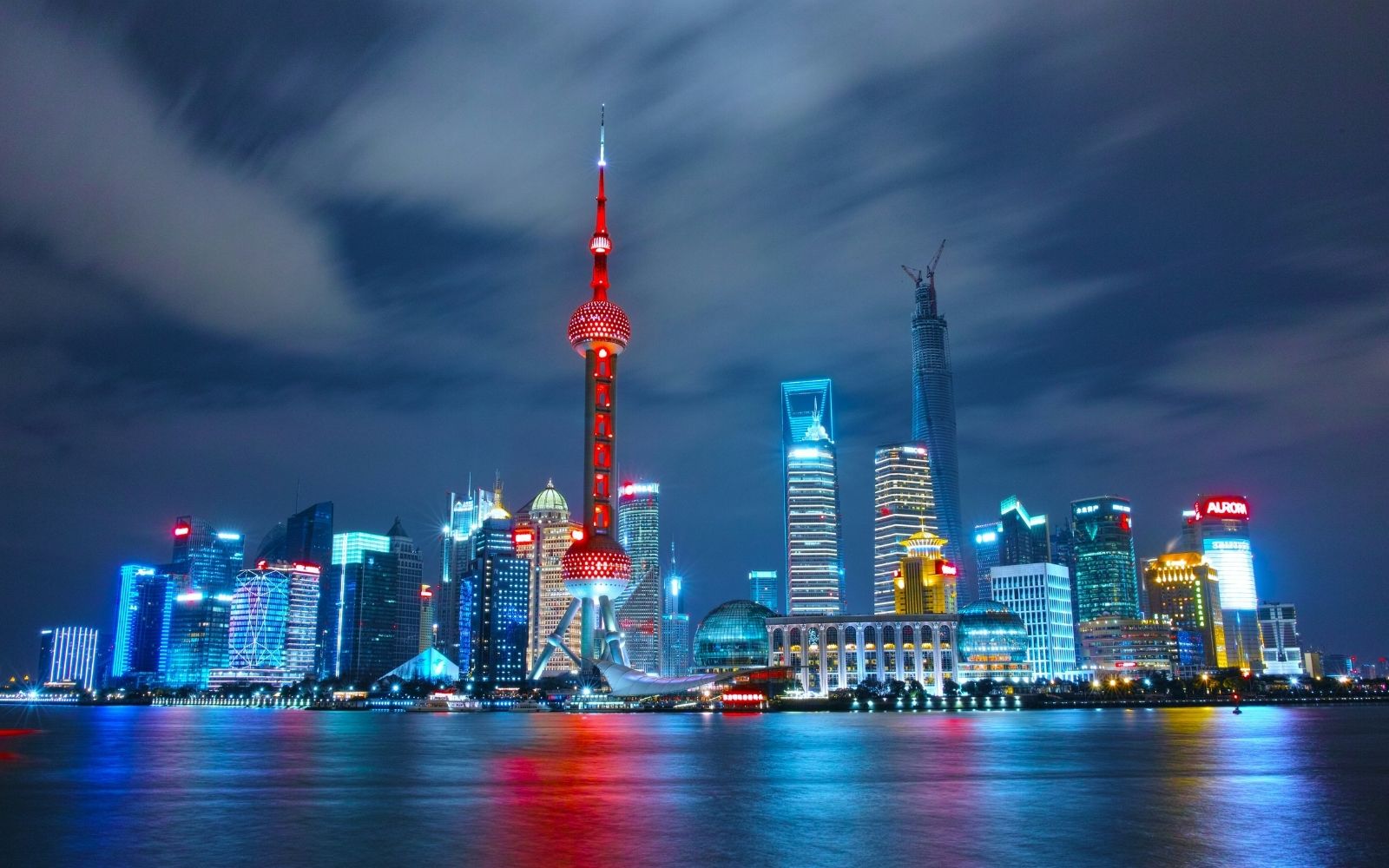
Shanghai arrived sunny. The Bund at sunset — 1.5 kilometres of promenade facing the Pudong skyline across the Huangpu — is still one of the great urban spectacles, and the crowds don’t diminish it. Tianzifang in the afternoon: old shikumen laneways converted into galleries and cafes, worth an hour. The Former French Concession is where the real time goes — Wukang Mansion (Shanghai’s Flatiron Building, a 1924 wedge-shaped apartment block that the city has decided is its main character), the plane-tree-canopied blocks of Wukang Road and Anfu Road, specialty coffee every 50 metres, concept stores that reward browsing. Yu Garden’s classical rockeries and koi ponds handle morning culture; 1933 Shanghai — a brutalist 1930s slaughterhouse converted into a creative complex with spiralling concrete ramps — is the genuine architectural discovery of the trip. Shanghai Tower’s observation deck at 632 metres, watched from the top at dusk as the Bund lights up 600 metres below, is the other non-negotiable. The nightlife geography — Arkham for techno, Dada for eclectic electronic, Potent for underground sets — all clustered around Julu Road and within walking distance of each other — is among the best in Asia.
Days 28–30: Hong Kong — Peak, Macau and Tang Court
The overnight sleeper from Shanghai arrives into West Kowloon mid-morning and the city grabs you immediately. The Star Ferry crossing for HK$2.50 and the historic double-decker tram (‘ding ding’, same price, any distance) handle the first afternoon efficiently. Victoria Peak on the Peak Tram in late afternoon — going up in daylight, staying for the city to light up below — is the mandatory move. M+ Contemporary Art Museum in West Kowloon was the other essential: one of the best new gallery buildings in the world, the collection is genuinely strong on contemporary Asian art and the building itself is extraordinary. Sai Ying Pun — west of Sheung Wan, steep lanes, third-wave coffee, natural wine bars, zero tourists — is the neighbourhood to anchor evenings in.
Macau came as an evening excursion by TurboJET ferry: Ruins of St Paul’s and Senado Square in the golden hour, Lord Stow’s Bakery egg tarts, a pork chop bun, and then The Venetian Macao — the world’s largest casino, so absurdly grand in scale that it loops back around to being genuinely impressive. A flutter on the tables and a late ferry back.
Day 30 was reserved for T’ang Court at The Langham in Tsim Sha Tsui — three Michelin stars, ten consecutive years, a dim sum lunch service that runs HK$500–800 per person and earns every dollar. The har gow and char siu bao are benchmarks. Dress smart casual and book well ahead.
Days 31–32: Taipei — Lanterns, Mountains and a Final Night Market
The HK Express hop to Taipei takes less than two hours. Drop bags and head straight to Jiufen Old Street by bus: a hillside village of narrow lantern-lit alleyways and tea houses overlooking the Pacific, the visual inspiration for Spirited Away and worth every cliché applied to it. Arriving in the late afternoon as the lanterns come on is ideal timing.
Taipei’s final full day started at Elephant Mountain — a 20-minute trail through city-edge greenery, open around the clock, delivering straight-on views of Taipei 101 lit against the night. The National Palace Museum holds one of the world’s great collections of Chinese imperial art and antiquities; allow three hours minimum and expect to leave feeling like you’ve only scratched the surface. Chiang Kai-shek Memorial Hall handles the big civic architecture tick. Beitou Hot Springs offered a genuinely restorative few hours of foot soaking in the free public baths before the airport. The final night market run — Ningxia for food-focused, Shilin for scale — closes things out properly. Pineapple cakes as souvenirs. Then the late-night flight home, carrying a lot of unprocessed photographs and the specific kind of tired that only several consecutive weeks of overnight trains can produce.
Beat visited South Korea, China, Hong Kong, Macau and Taiwan in May–June 2026.