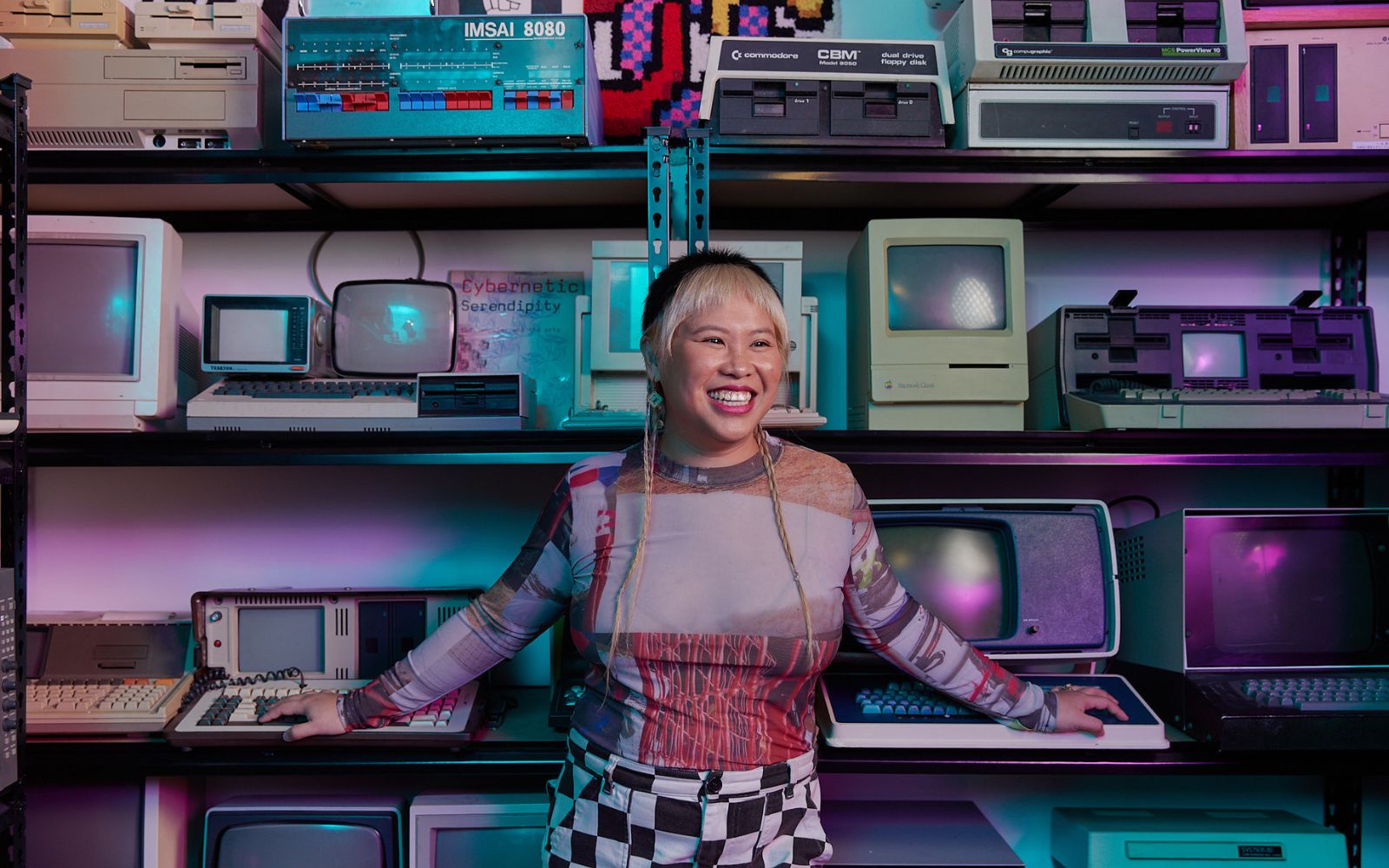
A room-sized supercomputer, a SEGA personal computer and a love letter to your childhood PC; all under one National Communication Museum roof.
Grab your floppy disks Melbourne, because the National Communication Museum is opening Radical Computing, a new exhibition tracing the wild evolution of personal computers.
Guest curated by designer and technologist Mel Huang, the show takes visitors from the days of room-sized, inaccessible machines through to the era when computers became something you could actually own and make your own.
Huang describes Radical Computing as her love letter to the personal computer and everyone who has ever tinkered, hacked or subverted the technology inside one.
Radical Computing at National Communication Museum
- National Communication Museum, 375 Burwood Rd, Hawthorn
- 19 September – 21 February
Stay up to date with what’s happening in and around Melbourne here.
View this post on Instagram
“This isn’t a historical or chronological story about the personal computer,” she says.
“Sure, it has 30+ vintage computers acknowledging that owning your own ‘computer’ was a radical idea, but it also celebrates the hackers, misfits, musicians, ravers, artists and weavers that have been stretching, breaking and tinkering with computing since its inception.”
At the centre of the exhibition sits a genuine piece of computing history: a Connection Machine CM-2, recently donated to the museum’s collection alongside a companion CM-5 by collector Karl Von Moller.
Built in the 1980s by Thinking Machines Corporation, the CM-2 was the first commercial supercomputer with a massively parallel architecture, packed with 65,536 processors behind translucent doors and blinking status lights.
Its design, led by industrial designer Tamiko Thiel, has become nearly as famous as its engineering, and Thiel has personally been involved in guiding its restoration by the museum’s Collections and Studio teams.
“I’m so excited to have Tamiko Thiel involved in the exhibition and grateful to NCM in saving and preserving a really important machine,” Huang says.
“Moving 1.5 tonne machines is no easy feat, so I’m so grateful to the team for that; I cannot wait to see the blinking lights! Tamiko’s drawings in particular of the 12D hypercube and early prototype ideas for the design of the Connection Machine are incredible to see.”
For all its scale, the CM-2 was never meant to loom over the people who used it.
“It was made to be not taller than Tamiko herself, so as not to present the supercomputer as an ‘overlord’ figure, and rather as a part of the team,” Huang explains.
“This paired in contrast to how the general public may feel about technology and artificial intelligence now. I think it gives a good perspective into how we could potentially learn from that design process and shift the way we design future technologies.”
The exhibition is deeply personal for Huang, whose family fled the Cambodian genocide and settled in Melbourne, where a hand-me-down computer from her uncle became her creative outlet.
“I remember late nights on instant messenger chatting with friends; I had a strict night curfew because my grandparents were used to living in commission housing in fairly rough neighbourhoods. So this meant everything to me, it was my connection to my friends,” she says.
“It was also a bonding moment for my aunty and I, we were 11 years apart, as we learnt how to use the computer, how to ‘get online’, how to get free cracked software, how to customise our Winamp skins and screensavers.”
That fascination eventually grew into the Buntine Computer Collection, which she founded with her partner Andrew back in 2016 after a SEGA SC-3000H — the brand’s only personal computer — was rescued from a back cupboard moments before their neighbour’s house was demolished.
“Thank goodness they thought to do a final check before taking a wrecking ball the place,” Huang says. Pieces from the collection appear throughout Radical Computing.
Since then, the collection has turned up in some unlikely spots.
“One of our rarest Australian computers, the Amust Executive, was pulled out of a back shed in a traditional antiques shop; the kind with plates and spoons rather than the more second-hand bric-a-brac places where you’d expect to find technology,” Huang says.
“Usually the suitcase has a sewing machine or a typewriter, but this time we opened it up and it was an Amust. We couldn’t believe it.”
“It’s one of five we know of in Australia, and someone we connected with online helped us track down software for it.”
Another find, an analog computer, turned up in the rafters of a sheet metal factory during a move-out, with no record of how it got there — “luckily someone thought it might be worth something and listed it online,” she says.
That hands-on approach extends to how Huang and her partner see themselves within the collecting world.
“We’ve met people from all walks of life, usually asking why young people like us are interested in this ‘junk’, and we make sure they know we’re not ‘flippers’; people who sell on their purchases for a profit,” Huang says. ”
“We’re very much dedicated to preserving these machines, getting them working again and sharing them with the world.” About 80 per cent of the collection is now in working order.
Beyond the Connection Machine, other highlights include Laurie Spiegel’s Music Mouse, an “intelligent instrument” from 1986 recently revived in partnership with Eventide, and the Demoshrine, an ode to underground hacking culture, early-90s raves and the demoscene.
Artworks from Tim Rodenbroker, Chia Amisola and Chok Si Xuan feature too, alongside plenty of hands-on, interactive experiences built for both hardcore computer nerds and families alike.
The exhibition also digs into a side of computing history that’s often overlooked, linking the craft of weaving and loom work back to the true origins of coding.
“There’s no doubt that the history of computing is entwined, no pun intended, with the Jacquard loom and its punch card system,” Huang says.
“But the reason weaving and patterns, in the form of dance and music-making, appear in the show is to highlight its very contemporary impact on the way artists approach computing. I think those stories are radical acts of computing, and are just as important as the story of business and the physical hardware development itself.
“Many people see creativity and craft as a completely separate act to coding and computing, but I’ve never seen it as being different — coding is a creative act in my mind.”
That thread continues through Melbourne artist Kate Geck’s tapestry work, and through young live coder Nu (Fetle Wondimu Nega), whose Code Jam workshops are teaching a new generation how to code live.
Arriving amid growing unease around artificial intelligence, surveillance and big tech’s grip on our digital lives, Radical Computing uses the Connection Machine as an unexpected entry point into that conversation; a machine built decades ago that was designed to show its own inner workings, rather than hide them.
Radical Computing opens on 19 September and runs right through to 21 February, spanning multiple school holiday periods, with a dedicated NCM summer program planned for families along the way.
For more information, head here.
This article was made in partnership with National Communication Museum.