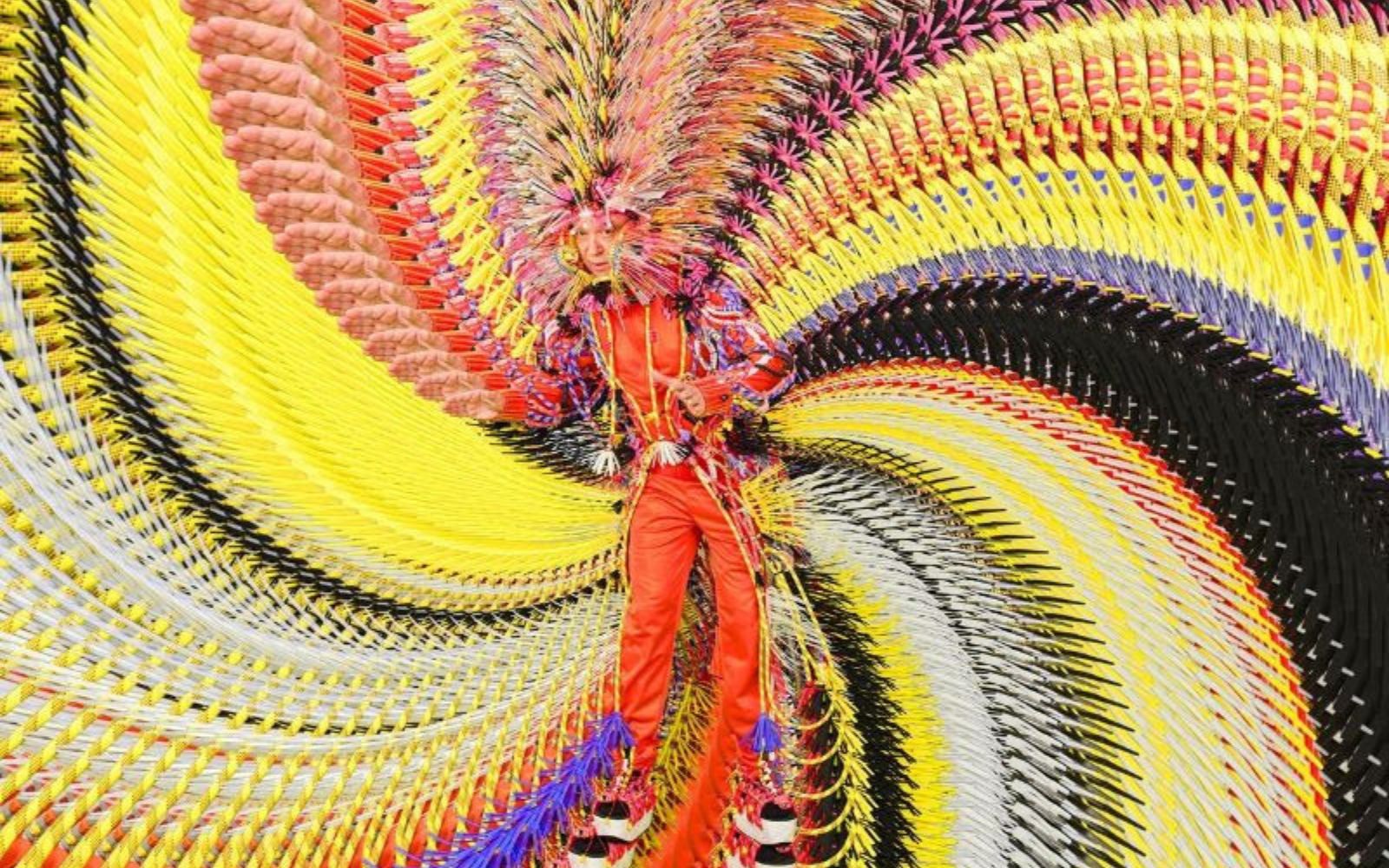
The former Talking Heads frontman brought his Who Is the Sky? tour to Melbourne with a theatrical production that ranks among his finest work
When David Byrne walked onto the Sidney Myer Music Bowl stage on 22 January wearing an orange jumpsuit alongside violinist Sara Caswell for a hushed rendition of Heaven, memories of Stop Making Sense came flooding back. That iconic 1984 concert film famously began with Byrne alone carrying a boombox, and four decades later, the 73-year-old is still finding ways to make those callbacks land with genuine emotional weight.
The stripped-back opener quickly gave way to something far more elaborate. As the remaining 12 members of Byrne’s ensemble gradually appeared in coordinated orange outfits and bright sneakers, the production revealed itself as something between a rock concert and a piece of performance art. Every musician wears a wireless rig, untethered from cables and able to move throughout the space in elaborate patterns devised by choreographer Steven Hoggett.
David Byrne – Who Is the Sky? Australian Tour
- 24 January, Adelaide Entertainment Centre
- 27 January, RAC Arena, Perth
Check out our gig guide here.
Perhaps the most striking revelation was just how heavily Byrne leaned into the Talking Heads catalogue. With 12 classics scattered throughout the 22-song setlist, including Psycho Killer, This Must Be the Place (Naive Melody), Life During Wartime and a euphoric Burning Down the House to close the encore, the evening felt like a generous gift to longtime devotees. For an artist with such an accomplished solo discography across albums like American Utopia and the new Who Is the Sky?, the willingness to dive deep into the back catalogue demonstrated remarkable generosity.
The massive wraparound LED panels transformed throughout the performance, shifting from lunar landscapes to Melbourne streetscapes to footage of Byrne’s actual New York apartment during My Apartment Is My Friend. When the orange jumpsuits and sneakers became luminescent under shifting lights, and the screens erupted into kaleidoscopic patterns during Once in a Lifetime, the effect was genuinely transcendent.
This is where pop experimentalism meets understated surrealism, delivered by an artist who remains one of music’s most inventive performers at any age.
For more information and tickets, head here.