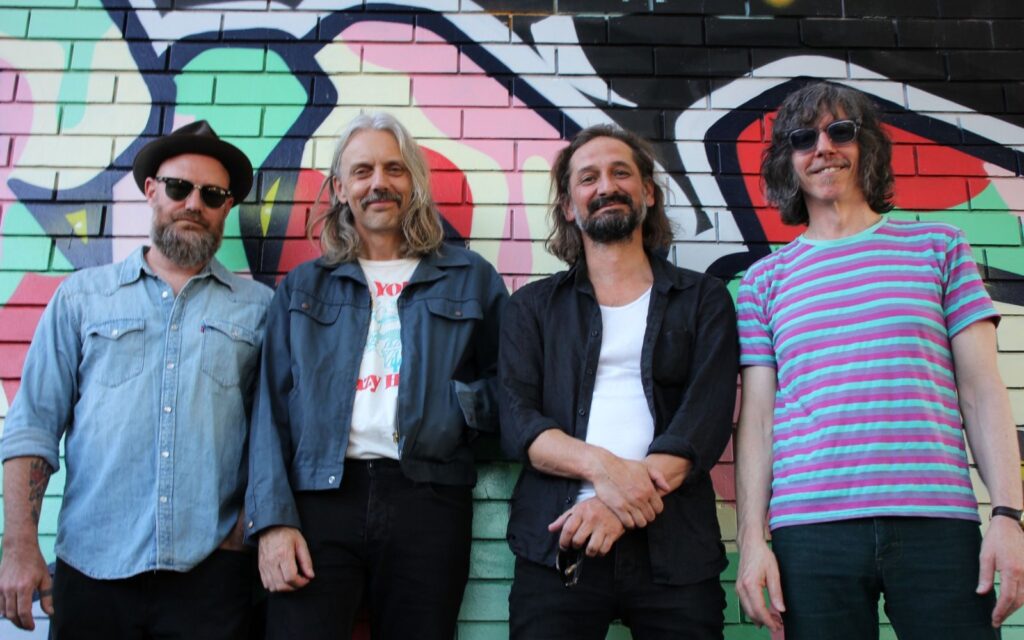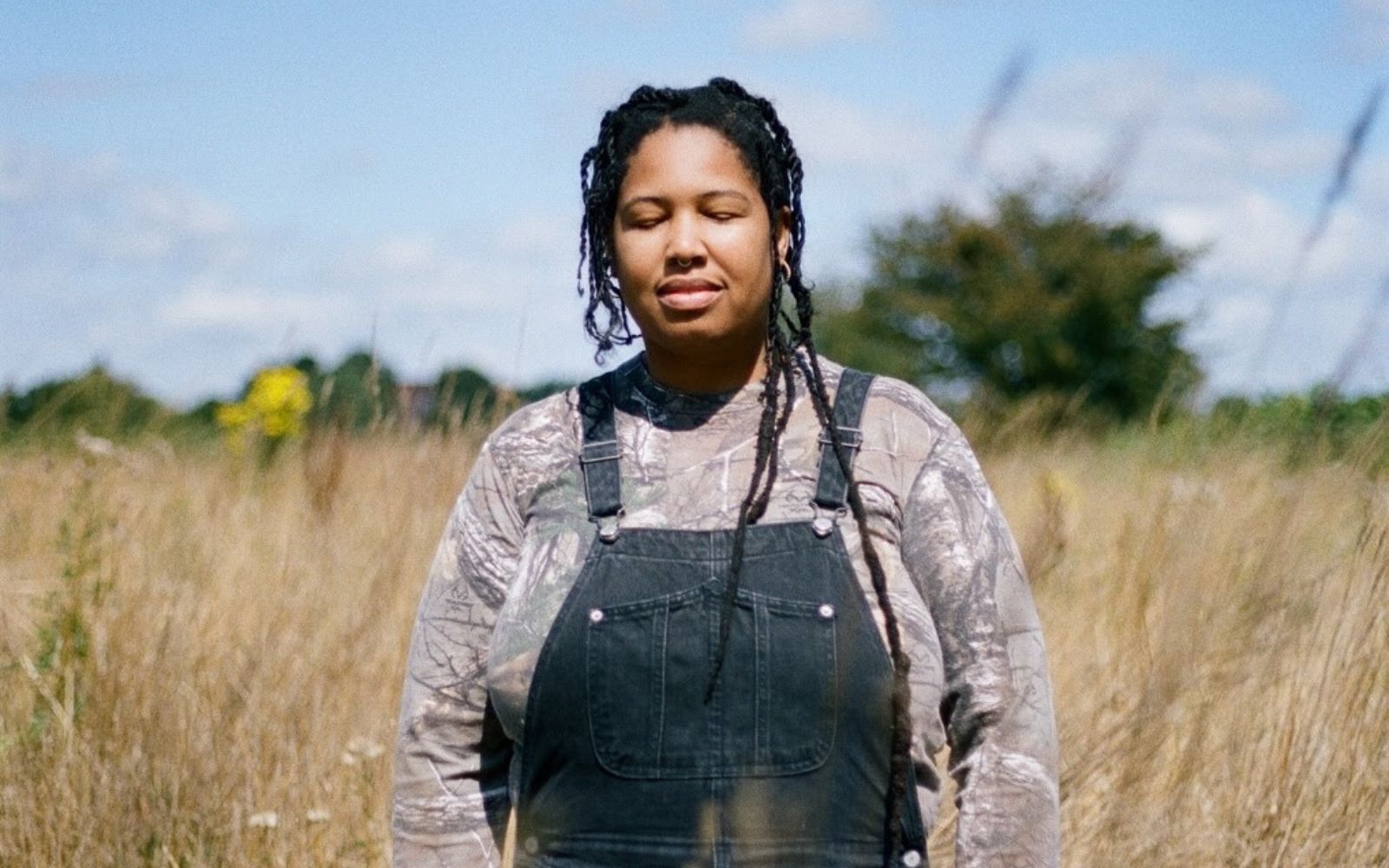
Doom-metal force Divide and Dissolve craft seismic, soul-stirring instrumentals that speak louder than words ever could.
Who needs lyrics when the music hits this hard?
Their recent release Insatiable isn’t just an album – it’s a living, breathing organism. Led by Black and Cherokee composer Takiaya Reed, the project channels doom metal’s raw power into something far deeper: a call for Indigenous sovereignty, an honouring of ancestors and a fierce resistance to white supremacy and colonial violence.
Divide and Dissolve
- 19 June
- The Tote
- Tickets here
Check out our gig guide, our festival guide, our live music venue guide and our nightclub guide. Follow us on Instagram here.
On the album, Takiaya pushes their sound further than ever, weaving crashing riffs, neoclassical textures and even vocals for the first time into a sweeping meditation on grief, impermanence and the possibility of freedom. Insatiable doesn’t ask for your attention – it commands it.
“I was channelling a lot,” they begin, reflecting on the album’s genesis. “I was thinking about love, and it felt really big inside of my chest. I needed to do something with these feelings. They were everywhere. So Insatiable is what came out.”
Insatiable stays true to Divide and Dissolve’s signature roots but with a refined, atmospheric edge. Takiaya Reed’s haunting saxophone work adds a brooding, almost cinematic layer to the thunderous guitars and relentless drums, anchoring the heaviness in something both soulful and unsettling. It’s a sound that feels at once deeply traditional and entirely their own.
Of course, the album is mostly instrumental – a deliberate choice. The band believes deeply in the power of nonverbal communication, in the vibrations of music as a universal language. “Our voices are such incredible tools, but most communication is nonverbal,” they explain. “I’m kind of obsessed with that. We don’t need words. I like that the music just feels – you can prove it over and over again. That’s the power of sound.”
Though Takiaya wanted to break that silence with the use of vocals, even if it is just for a moment. On the track Grief, Takiaya’s distorted voice cuts through the heavy drone, repeating: “I don’t know what I’m supposed to do/ I’m so lonely without you.” It’s a raw and haunting moment made more powerful by its rarity.
“The voice is such a mysterious instrument,” they say. “This album feels different, and I wanted to honour that.”
View this post on Instagram
The inclusion of vocals may be subtle, but it marks a shift in the project’s evolution. Insatiable expands the sonic palette of Divide and Dissolve: the moments of near silence punctuate the chaos, creating space for reflection.
While doom metal might seem like an unlikely genre to express love, Takiaya flips that expectation on its head. Love, instead, is used as a revolutionary force. “Love is the highest power,” they say. “And anything is possible with love. Things that feel impossible, systems that seem unbreakable, can move or even end with love. That’s why it’s my main focus.
“You know, I’m Black and I’m Native – I’m Cherokee,” they continue. “I think about the displacement of Indigenous people around the world. I think about the descendants of slaves. And I think, ‘wow, so much had to happen for us to even be able to have this conversation.’”
This kind of love isn’t soft or naive. It’s the kind that digs its roots into the soil of ancestral memory, drawing power from histories of displacement, struggle and resilience.
Still, Insatiable stays true to its roots. It remains an unflinching confrontation of systemic violence. But it also asks: what happens after the destruction? What does healing look like? What kind of world can we build if we let love lead?
They describe the album as a kind of offering to the future, an act of care that might not bear fruit in their own lifetime. “One of my friends said to me, ‘It’s like planting a tree you won’t eat the fruit of.’ That’s what this is. That’s what love is, to me. And that’s beautiful.”
They laugh when asked about performing the album live at the Tote in June. “I’ll play my heart out,” they say, without effect. “That’s what people can expect on June 19th.”
Still, at the core of all of this – the sound, the resistance, the meditations on lineage and healing – is something beautifully human: the desire to live well and to let others live well, too.
“I’m just out here trying to live a good life,” she says. “I just want to feel good. I don’t want to make people feel bad. I want to humanise myself, my experience. That’s what Insatiable is. It’s a love letter. It’s me trying.”
Divide and Dissolve are playing at The Tote on 19 June. Get tickets here.