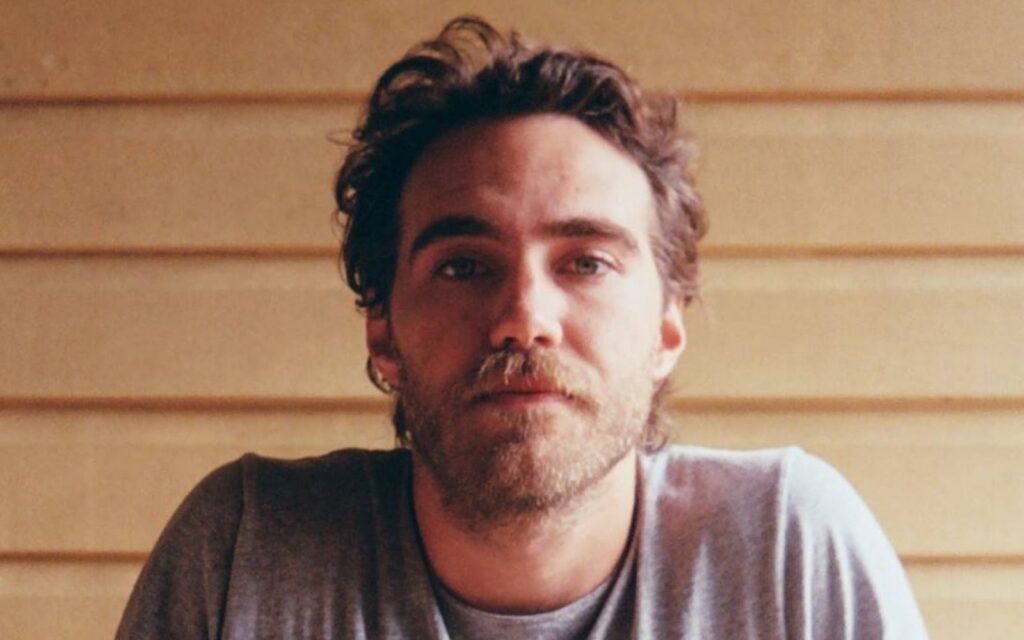
“I’ve just been a little bit run down, man,” he apologises. Though, given I’m the jerk interrupting his recovery, it’s me who should be playing the apology card. “I woke up this morning and my throat was gone, so I’ve been trying to sleep as much as possible. Over the last couple of weeks I’ve been constantly run down, it’s quite frustrating.”
Since releasing his third album Utopia last June, Colwell’s been criss-crossing the country with frightening commitment, and there are still plenty of gigs to go. It’s all too easy to imagine his life as one of endless revelry, quaffing champagne while dangling out the windows of tour buses, but the reality of success is much more practical.
“The main thing is you have to sleep as much as possible,” he says. “When I first started touring, I was heavily into partying, so I was drinking, doing a lot of drugs on tour, and that really fucks you up. You just end up trashing yourself and you get so sick. Even when I’m sober and not partying, I still try and sleep as much as possible. You’ll finish a gig around midnight, one o’clock, and then you get home and you’re still full of adrenalin so you don’t sleep until four in the morning anyway, and then you’ve got to get up at eight or nine to drive seven hours to the next one. It’s quite vicious. I think nowadays, now that I’m older, I treat it more like work, rather than a big party. Back in the day it was insane, we were so loose. But now it’s about looking after ourselves.”
Having spoken with several Aussie hip hop acts, the prevailing impression you get from them is an unparalleled enthusiasm for emerging talent in their genre. Fostering up-and-coming talent is a driving desire, given that for many in the field – from 360 to Hilltop Hoods – without receiving early support themselves, they might never have cracked the surface. Lately, 360 has been taking a hands-on approach to promoting fresh voices.
“I’ve got this song with an English rapper,” he says, “where I do the first two verses and he does the third, and so for the major cities and some of the regionals we have this comp where young rappers can upload a video of them doing his verse, or do their own verse over it, and just post it to me on Facebook. We’ve been picking the best ones and at these gigs we’re getting people up to rap. There’s been some amazing entries, man. In Sydney we chose four, they were all so sick. It’s been really cool, especially to see how many female rappers have been entering. There are some kids who are 18 or younger who are so good it’s crazy.”
Though, it’s not all wine and roses in the industry. While every genre has its purists, in hip hop there can be a lot of negativity, not just between fans, but between performers themselves.
“Oh man, it can be extremely negative,” says Colwell. “People like myself, who make music that has a lot of pop elements in it, with some of these hip hop purists it’s a real no-no. I’m someone who’s copped a lot of hate from a lot of rappers, almost being shunned, saying I don’t make real hip hop, all that kind of shit. It’s funny. I don’t know if it’s the same for many other genres, but it feels like the politics of what can and can’t be done, what the rules are, seems really prominent in hip hop. You have to stick to making ‘classic’ hip hop, you can’t rap with a dance beat, that’s not what hip hop’s about. Shit like that, and I don’t know if that really happens in other genres. It’s really intense.”
Before I let the poor guy go and recover, talk turns to the cornea transplant that prompted Colwell’s turn to music. From the sudden end of one dream emerged an unlikely blessing in disguise.
“You know, I do feel like it was a blessing,” he says. “I was obsessed with basketball back then and nothing was going to stop me. I wasn’t even that good, truthfully, but when my eye started going down I lost my passion for basketball completely and it made me focus on music as my main love. At the time though it really fucked with my head. Suddenly I couldn’t play basketball and that was all I’d wanted to do. Back then I was working at an apprenticeship in carpentry, and [MC] Pez said to me, ‘Fuck working all the time. We only live once, so let’s do this music thing for real.’ I quit that weekend, and the rest is history.”
BY ADAM NORRIS