Some years later Morris completed his training and was admitted to the priesthood. A life-long cinephile, Morris was eventually able to conflate his theological and cinematic interests when he was appointed Professor of Religion and the Arts at the Dominican School of Philosophy and Theology in Berkeley, California. Father Morris’s course currently comprises 15 separate aspects analysing the interaction between film and biblical narrative. For one aspect of the course, Father Morris began collecting cinematic poster art – “for when I needed to do PowerPoint presentations,” he laughs.
It’s this rich collection that forms the cornerstone of the Epic! 100 Years Of Film And The Bible exhibition, that will be opening at the Jewish Museum of Australia from Thursday 30 August until Sunday 3 February. Comprising posters from Old Testament films from the United States, Europe, Mexico, Australia and other countries, the collection illustrates the strong and complex interaction between biblical and cinematic narrative over the last hundred years of filmmaking. Grouped into four thematic categories – Violence and Catastrophe, Gender and Sexuality, Magnificence and the Monumental and Righteousness and Redemption – the exhibition includes posters and stills from films as diverse as David and Goliath, The Private Lives of Adam and Eve, Samson and Delilah and the 1928 production Noah’s Ark.
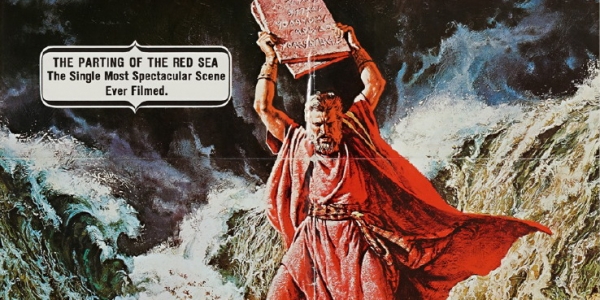
The cinema poster has long been a particularly striking art form. In the days before saturating electronic media promotion, the humble cinema poster was effectively the only promotional vehicle. “That’s been the case from 1895 through to the present day,” Father Morris says. “It’s one art form that’s supposed to get people into another art form. And when you look at film posters you can find all sorts of different meanings being used – alluring, adventurous, monumental.”
Beyond the posters, Morris agrees that the narrative conveyed in biblical cinema has tended to overshadow, and in some cases subvert, the stories found in the Bible. “Absolutely,” he says. “That’s why people tend to get their bible stories from film. You have people like Cecil B. DeMille who added bits to the stories in his films to spice it up – like the childhood context between Moses and the Pharaoh in The Ten Commandments, which doesn’t appear in the story in the Bible. But it makes for a good story, and that’s what people enjoy.”
Father Morris admits that, as a trained priest, he’s unable to completely divorce his theological perspective from his artistic interest. “There’s always an element of theological scrutiny to give to any film,” he says. While the gratuitous battle between Moses and the Pharaoh can be put down to artistic licence, exercised in the name of entertainment, there are other occasions when the gulf between cinematic and biblical narrative is almost comic. “You look at a film like Sodom and Gomorrah, and homosexuality isn’t mentioned at all, but the word sodomite comes from Sodom,” Father Morris says. “And then you have this scene when the Queen of Sodom calls out ‘Welcome Sodomites,’ and it’s only today when you see that and you just have to laugh,” he laughs.
Sodom and Gomorrah is one extreme example of film’s inability to deal with sexuality; in the case of films dealing with Adam and Eve, nudity is necessarily part of the script. “It’s hard to think of Adam and Even with their clothes on before The Fall. How do you film that without nudity? The Mexican production of Adam and Eve may seem titillating to some, but it’s very tastefully done. And you’ve got to realise that there are issues of human virtue and human vice all through the Bible,” Father Morris says.
While Bible stories continue to appear regularly in American and European cinema – Mel Gibson’s Passion of the Christ being a recent, and controversial, example – the interpretation and presentation of the biblical narrative has tended to reflect the surrounding political and cultural environment. “For example, after World War II you had a lot of people looking to religion – it was an era of great devotion at that time. The films of the time, like The Ten Commandments, reflected that reverence. Whereas recently that’s been less so – films now tend to wrest you into a different situation, like Mel Gibson’s movie,” Father Morris says.
And then there are the international comparisons. “The United States tends to like a story that’s entertaining, whereas in Europe there’s more of a focus on the artistic aspect,” Father Morris says. “You have someone like Cecil B. DeMille who took more of a P.T. Barnum style to his films – but he definitely knew how to tell a story. His films were certainly spectacular.”
Father Morris says the favourite poster in his collection is for The Story of Ruth; his favourite film, not surprisingly, remains The Ten Commandments. “It’s stuck in my head, and branded on my brain,” Father Morris laughs. “I love watching it now, even thought it’s got elements of kitsch. And the parting of the seas still looks great, even though you can do so much better with computer animation these days.”
BY PATRICK EMERY